Women's Health Research
After menopause, your exhausted adrenal glands steal silica from your hair follicles to keep your organs alive. No standard blood test detects it — and it explains why everything else you've tried has failed.
Sarah Whitfield
Health & Wellness Correspondent
March 21, 2026
She washed her hair this morning and didn't think about it. Just rinsed, conditioned, ran her fingers through it. No breath-holding. No counting strands in the drain. No anxiety ritual.
Eighteen months ago, that would have been unthinkable. She was the woman standing in harsh bathroom light with wet hair, checking for new thin spots. The woman who dreaded showers. Who spent over $800 on dermatologist visits, supplements, and treatments that did nothing.
Her story is not unusual. Across online forums and private support groups, thousands of women over 55 describe the same pattern: hair loss that accelerates years after menopause, blood tests that come back normal, and a growing list of failed treatments. What most of them don't know — what most of their doctors don't test for — is a mineral deficiency hiding in plain sight.
There is no standard blood test for silica levels. It is the mineral that holds your hair in your follicles — and after menopause, your body is actively stealing it from your scalp.
The typical path looks like this: a woman notices more hair on her pillow, more in the shower drain, more on her shoulders throughout the day. She waits a few months, hoping it's seasonal. When it doesn't stop, she visits her doctor.
Blood work is ordered. Iron, ferritin, thyroid, B12, hormones — the usual panel. Results come back within normal range. The doctor suggests minoxidil, biotin supplements, or simply waiting it out. The woman tries one or more of these. Nothing changes.
What's missing from this picture is silica — the mineral that forms the collagen matrix holding each hair follicle in place. Think of collagen as the glue that anchors your hair to your scalp. Without silica, that collagen can't form properly. The follicle loosens. The hair falls out. And no amount of biotin, iron, or collagen supplements can fix it — because the structural foundation is gone.
The reason doctors miss it: there is no standard diagnostic test for silica levels. It simply isn't part of any routine blood panel. A woman can have perfect labs and still be profoundly silica-depleted at the follicle level.
“We test for everything we have tests for — thyroid, iron, hormones. But silica isn't on the panel. It's a blind spot in women's health. When I started connecting post-menopausal adrenal exhaustion with silica redistribution, the pattern became impossible to ignore. These women aren't losing hair because something is wrong with their follicles. They're losing hair because their body is redirecting the one mineral that holds those follicles in place.”
Dr. Rebecca Thornton
Board-Certified Endocrinologist, 22 Years in Practice
The mechanism is straightforward once you see it. During reproductive years, your ovaries handle the heavy lifting of hormone production. When menopause arrives, your adrenal glands take over — going into overdrive to compensate for ovarian shutdown.
Years later, those adrenal glands are exhausted. They've been working double shifts for a decade or more. And now they face a resource crisis: the body's silica supply is limited, and every organ needs it. Your heart, liver, kidneys, bones, and joints all require silica to function. Your hair follicles need it too — but they're at the bottom of the priority list.
Survival over beauty. Your body makes a triage decision. Silica gets redirected from your scalp to your vital organs. Your hair follicles — deprived of the one mineral that holds them in place — begin to release. Not all at once. Gradually. Progressive depletion that gets worse the further past menopause you get.
This is why the timeline matters. Many women report that hair loss didn't start during menopause — it started years after. The lag is the adrenal depletion catching up. By the time it's visible, the theft has been happening for months.
"Your ferritin could be 100. Your thyroid perfect. Hormones balanced. But without silica, your hair can't stay attached. And the older you get past menopause, the worse it gets."
Once you understand the silica theft mechanism, the failure of conventional treatments becomes obvious. Biotin doesn't address silica. Collagen supplements can't help if your body can't form new collagen — because it lacks silica. Iron levels are irrelevant if the structural matrix is compromised. DHT blockers target male-pattern hair loss, which operates on an entirely different mechanism.
Even rosemary oil and scalp massage — popular home remedies — only address surface-level blood flow. They don't replace the depleted mineral or stop the adrenal redistribution driving the loss.
The solution requires two things simultaneously: flood the system with bioavailable silica so the follicle matrix can rebuild, and support the exhausted adrenal glands so they stop stealing it. Most synthetic silica supplements barely absorb — the body can't use them efficiently. But horsetail extract, a plant-derived source, delivers silica with approximately 70% bioavailability. Paired with pantothenic acid (vitamin B5) for adrenal support, the two work in tandem: replace what's missing and stop the theft at its source.
Women following this protocol report a consistent pattern. The shedding slows within the first three weeks. By month two, the obsessive checking stops — not because they forced themselves, but because there's nothing alarming to find. By month three, hairdressers start commenting.
Bioavailable Silica + Adrenal Support
★★★★★ 4.7/5 from verified customers
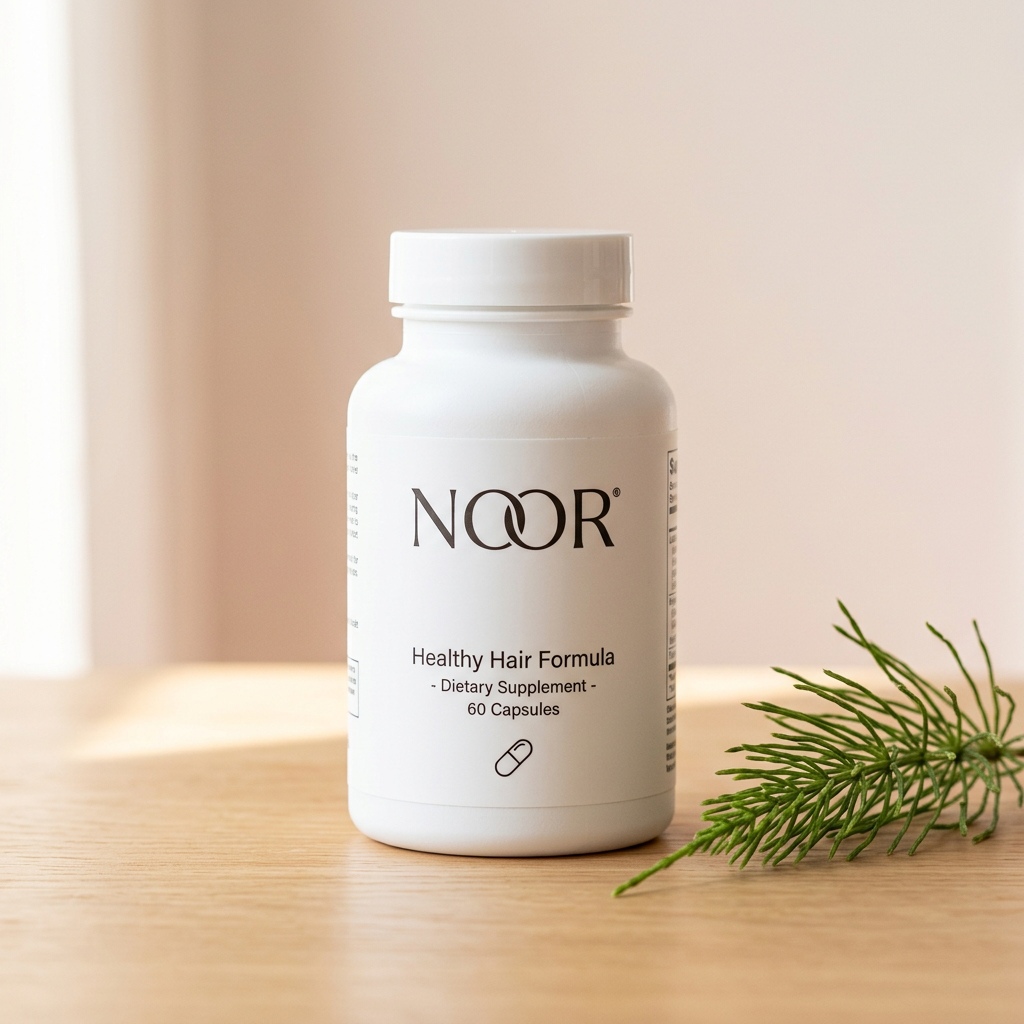
Noor's Healthy Hair Formula combines high-potency horsetail extract (440mg, standardized to 7% silica) with 500mg pantothenic acid — the two ingredients that address the root mechanism behind post-menopausal hair loss. Not a multivitamin with 30 ingredients at token doses. Two targeted compounds at clinical doses, designed to do two things: replenish follicle-level silica and calm the adrenal stress driving the depletion.
$39.95 per bottle | 180-Day Money-Back Guarantee — return even empty bottles
“Week three, I realized I hadn't checked the shower drain in days. That used to be the first thing I did every morning. By month three, my hairdresser said 'your hair is coming back.' Three words I'd been waiting almost a year to hear.”
— Margaret L.
Verified Buyer
“I spent over $800 on dermatologists, supplements, and treatments. Everything came back 'normal' but my hair kept falling out. Once I understood the silica thing, it finally made sense. Two months in and the shedding has stopped. I'm not checking anymore. I'm just living.”
— Diane R.
Verified Buyer
“My sister tried it after seeing my results. She's 62 and had been dealing with the same thing for two years. Three weeks in, she texted me a photo of her shower drain. Clean. She just wanted to share that moment with someone who would understand.”
— Carol A.
Verified Buyer
Use the full bottle. If you don't see real results — less shedding, better texture, hair that stays where it belongs — send the empty bottle back for a full refund. 180 days. No questions, no hassle. We recommend the 3 or 6-month supply because the protocol builds over time: shedding slows in weeks 2-3, texture returns by month 2, visible regrowth by month 3.
Common Questions
Because there's no standard blood test for it. Silica isn't part of any routine panel — not even specialized hair loss panels. Doctors test for what they can measure: iron, ferritin, thyroid, hormones. When those come back normal, they move to topical treatments like minoxidil. The silica blind spot means millions of women are treating symptoms while the root cause goes unaddressed.
Most silica supplements use synthetic forms that the body can barely absorb — bioavailability as low as 1-5%. Horsetail extract is one of the few plant-derived sources with meaningful absorption rates (approximately 70%). The 440mg dose in Noor's formula is standardized to 7% silica content, delivering a clinically relevant amount that actually reaches the follicle level.
No. The formula works at the mineral and adrenal support level — it doesn't interact with hormonal pathways. Horsetail extract and pantothenic acid are both well-studied, non-hormonal ingredients. That said, as with any supplement, consult your physician if you have specific concerns about interactions with your current medications.
The pattern is consistent across most women: shedding slows noticeably within 2-3 weeks. The obsessive checking and drain anxiety typically fade by month 2 — not from willpower, but because there's less to find. Visible improvement in texture and density usually appears by month 3. The 180-day guarantee gives you a full 6 months to evaluate.
No. The adrenal silica redistribution is ongoing — which means it can be addressed at any stage. Women in their late 60s and early 70s report the same timeline of improvement. The key factor isn't how long you've been losing hair — it's whether the follicles are still present in the scalp (even dormant ones can be reactivated when the collagen matrix is restored).
FREE SHIPPING ENDS IN